IPM models and degree-days - Frequently Asked Questions (FAQ)
1. What are degree-days and what are they used for?
Degree days are often known as heat units or thermal units; they are the summation of temperature over time. Usually
degree-days are only counted above a lower temperature threshold, sometimes an upper threshold is also used.
Degree-day concepts are explained in detail at the UC Davis website:
http://www.ipm.ucdavis.edu/WEATHER/ddconcepts.html#Degree-day concepts
2. What is a biofix?
A biofix is the date to start accumulating degree-days for a particular model. An example is
the first date of catch in a pheromone trap (such as for codling moth). Whatever amount of degree-days have accumlated so far for that year, they are reset to zero on the biofix.
3. How are degree-days calculated?
Various simple and complicated methods all more or less try to integrate the temperature between thresholds over a one-day interval.
The simplest calculation of a degree-day requires the daily maximum and minimum temperature, a lower threshold (such as 50 degrees Fahrenheit), and a formula such as the simplest method: ((MAX + MIN) / 2) - Lower Threshold. Other popular formulae include single and double triangulation, single and double sine curve, and real time degree-days. Real time accumulators, often found in "biophenometer" type instruments, monitor the temperature at short intervals such as every 5 minutes, so they are slightly more accurate than are degree-day estimates that are based only on daily max-min temperatures. A "single" calculation degree-day uses the daily max and min for that day only. A "double" calculation degree-day uses todays min, today's max, and tomorrows min, and can be slightly more accurate, especially during warming or cooling trends. Most degree-day models are not so precise that it matters much which calculation method is used, and it is perhaps best to copy the method that was originally used to produce the model. Calculation methods and formulae are described in greater detail at the UC davis website:
http://www.ipm.ucdavis.edu/WEATHER/ddconcepts.html#Degree-day calculation methods
4. How do I interpret degree-day calculations?
Simply, degree-days attempt to take some of the seasonal fluctuations out of predicting
the timing of events that are influenced by temperature. For example, if egg hatch occurs
12-30 days after egg-laying (depending on the temperature), that might take only
only 100 degree-days plus or minus 10. So if you observe the time of egg-laying, you
can add up the degree-days every day thereafter until 90-110 degree-days
accumulate, and you can expect egg hatch to occur. Using degree-days can greatly increase
precision of forecasting critical life stages and management events, and is an integral part of IPM programs.
5. How do I access weather data and calculate degree-days in Oregon?
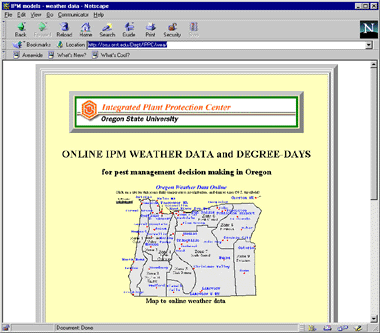
Go to the Oregon State University/Integrated Plant Protection Center webpages starting at:
http://osu.orst.edu/dept/ippc/wea/
6. How do I know what pests and crops are available for degree day models?
There is a catalog of species that have been studied (and published) at the UC Davis web site:
http://www.ipm.ucdavis.edu/PHENOLOGY/models.html
7. What pests and crops are on-line via the Web in Oregon?
A. The list of species that have thresholds automatically entered is found on the
http://osu.orst.edu/Dept/IPPC/wea/weacalc.html page, and
currently consists of:
- black cutworm (Tlo=50, Thi=86)
- cabbage looper (Tlo=50, Thi=90)
- codling moth (Tlo=50, Thi=88)
- corn earworm (Tlo=45, Thi=92)
- eur. pine shoot moth (Tlo=28)
- orange tortrix (Tlo=41, Thi=90)
- pea aphid (Tlo=42, Thi=82)
- variegated cutworm (Tlo=45 Thi=80)
- 2-spot spider mite (Tlo=50)
B. Online species models, including thresholds, biofix, calculation method, and key life stage/managment events, are at the page:
http://osu.orst.edu/Dept/IPPC/wea/weamodl.html and currently include:
- codling moth [apple & pear] (Brunner & Hoyt 1987)
- european pine shoot moth [ornamentals] (Regan et al. 1991)
- filbertworm [hazelnut] (AliNiazee 1983)
- strawberry root weevil [peppermint] (Cacka 1982)
- sweetcorn crop development (Jubilee; Coop et al. 1993)
- variegated cutworm [peppermint] (Coop 1987)
- western cherry fruit fly [cherry] (AliNiazee 1979)
8. What new features will be available at the OSU/IPPC weather data/degree-day website in coming years?
- more models for more pests, beneficials, and crops
- more weather sites
- graphs of model outputs
- better documentation and validation of models
- ability to calculate degree-days for previous years
- forecasts - using average historical and other types of weather data
- maps - where degree-days are predicted over entire regions and made into maps
[Intro]
[Data Table]
[Data Map]
[DD Calc]
[DD Models]
[Links]

This project funded in part by a grant from the USDA-Western Regional IPM program.
On-line since April 5, 1996
This page updated Oct. 10, 1997
Contact Len Coop, Research Associate, IPPC/Entomology Dept, OSU, at coopl@bcc.orst.edu phone: 541-737-5523 if you have any questions about this information or problem accessing features of this page.